Cambridge Education in Rwanda: What Parents Need to Know About This Programme
If you have been exploring schools in Kigali, you have probably noticed the word “Cambridge” on school websites, brochures and fee pages. But what does it actually mean for your child? Is it just a name, or a different way of learning?
Cambridge education in Rwanda is an international programme offered by a growing number of schools. It follows a clear, step-by-step pathway from early primary school to the final years of secondary school, with internationally recognised qualifications along the way. This guide explains the programme in plain language, so you can decide whether it suits your child and your family’s plans.
In this guide, you will learn:
- What Cambridge education is and who is behind it
- The four stages of the Cambridge pathway and the ages they cover
- What children study at each stage
- How Cambridge exams and qualifications work (Checkpoint, IGCSE, AS and A Level)
- How Cambridge compares with the Rwandan national curriculum
- The benefits and the things to consider
- How to know if Cambridge is right for your child
- Frequently asked questions
- How to take the next step
What Is Cambridge Education?
Cambridge education is an international curriculum and qualification system run by Cambridge University Press & Assessment, which is part of the University of Cambridge. Its international arm, Cambridge Assessment International Education, serves schools around the world. Schools that offer the programme follow Cambridge syllabuses and prepare students for Cambridge assessments.
In simple terms, it is a structured learning journey for students aged 5 to 19, designed to build knowledge, critical thinking, communication and problem-solving skills, not just memorisation.
The Cambridge Pathway: Four Stages for Ages 5 to 19
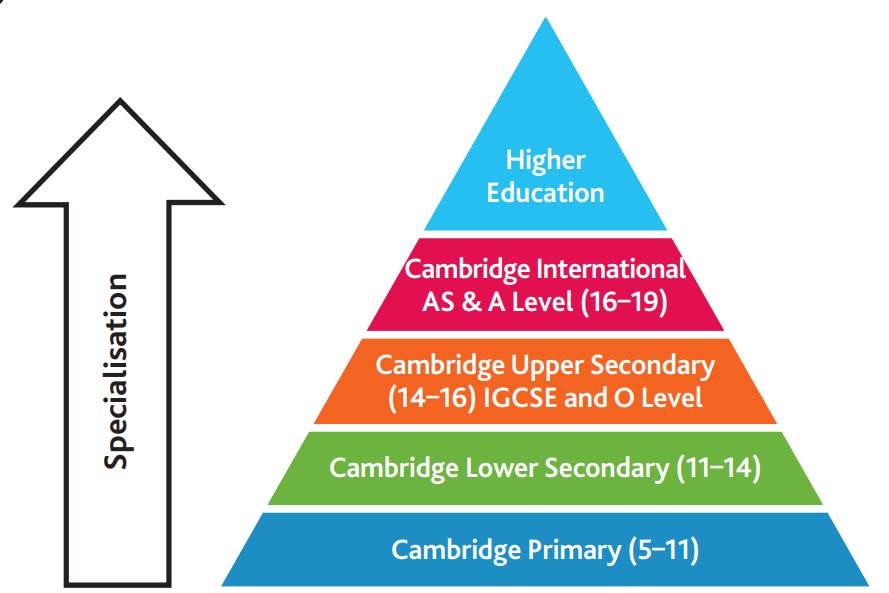
The programme is called the Cambridge Pathway. It has four stages, and each prepares students for the next. Schools can offer all the stages or only some.
|
Stage |
Typical age |
Duration |
What it leads to |
|
Cambridge Primary |
5–11 |
6 years |
Optional Primary Checkpoint tests |
|
Cambridge Lower Secondary |
11–14 |
3 years |
Optional Lower Secondary Checkpoint tests |
|
Cambridge Upper Secondary |
14–16 |
2 years |
Cambridge IGCSE qualifications |
|
Cambridge Advanced |
16–19 |
1 to 2 years |
Cambridge International AS & A Level qualifications |
Cambridge Primary (ages 5 to 11)
This stage builds strong foundations in English, mathematics and science, alongside subjects such as Global Perspectives, digital literacy, art and music. Learning is designed to encourage curiosity, questions and confidence.
Cambridge Lower Secondary (ages 11 to 14)
Students carry everything from primary into deeper study. This is the bridge year group, where learners get ready for the more demanding qualification stage ahead.
Cambridge Upper Secondary (ages 14 to 16)
Students prepare for the International General Certificate of Secondary Education (IGCSE). It is subject-based, so students choose subjects and are graded in each one separately.
Cambridge Advanced (ages 16 to 19)
Students work toward Cambridge International AS Level and A Level qualifications. The AS (Advanced Subsidiary) Level typically takes one year and is half of a full A Level, which typically takes two years. There are no compulsory subjects, so students can build a combination that matches their goals.
How Cambridge Assessment Works
Cambridge is not only about the final exam. There are checkpoints along the way:
- Cambridge Checkpoint tests are optional tests at the end of Primary and Lower Secondary. They are marked by Cambridge and give an external, international benchmark of a student’s progress in English, mathematics and science. They are diagnostic, meaning they show strengths and gaps rather than awarding a final grade.
- IGCSE is the first formal, graded qualification, taken at around age 16.
- AS and A Level are the advanced qualifications, taken at the end of secondary school and widely used for university applications.
Schools can choose whether students sit exams at each stage, so it is worth asking any school how they use Checkpoint results.
Is Cambridge Recognised Around the World?
Yes, this is one of the main reasons parents choose it. Independent benchmarking by the UK’s recognition agency (UK NARIC, now Ecctis) found Cambridge IGCSE comparable to the UK GCSE and Cambridge International AS & A Level comparable to the UK A Level. Universities around the world accept these qualifications.
If your child plans to study in Rwanda or elsewhere in Africa, it is wise to check the specific entry and equivalence requirements of the university or country you have in mind well in advance, because rules differ between institutions.
Cambridge vs the Rwandan National Curriculum
Rwanda’s national schools follow the Competence-Based Curriculum (CBC), introduced by the Rwanda Education Board (REB). Many Rwandan parents ask how the two compare. Neither is simply “better”. They are designed for different purposes.
|
Cambridge |
National curriculum (CBC) |
|
|
Origin |
International |
Rwandan |
|
Qualifications |
IGCSE, AS and A Level |
National examinations |
|
Strength |
Global recognition, portability between international schools |
Local grounding and national pathway |
|
Transfer |
Students can continue the same curriculum if they move between Cambridge schools, including abroad |
Designed for Rwanda’s system |
Some parents choose Cambridge because it is portable. A child who moves cities or countries can often continue the same programme. Others prefer the national pathway for its local focus. The right choice depends on your child’s future plans, which is why a conversation with the school is worth having.
Benefits of Cambridge Education for Your Child
- A clear path from age 5 to 19, so learning builds step by step.
- Skills, not just facts: critical thinking, problem-solving, research and presentation.
- Internationally recognised qualifications that open doors to universities and careers worldwide.
- A global outlook, with subjects like Global Perspectives that connect learning to the wider world.
- Language strength: English is the main language of instruction, which supports study at international universities.
- Consistent standards, because exams are set and marked to an international benchmark.
Things to Consider Before Choosing
A balanced decision means looking at the whole picture:
- Language: Cambridge learning is delivered in English. Ask how the school supports children who are still building their English, and how local languages such as Kinyarwanda are included.
- Fees and extras: Cambridge exams, textbooks and materials usually cost extra. Ask for the full fee structure, including exam fees.
- School quality: Not every school delivers the programme equally well. Ask whether the school is officially a Cambridge school and a Cambridge exam centre.
- Fit for your child: The programme is rigorous. Ask about learning support for students who need extra help.
Is Cambridge Right for My Child?
Cambridge may be a strong fit if:
- you want your child to be ready for study at universities in Rwanda or abroad
- you value critical thinking and communication as much as exam results
- your family may relocate and you want continuity in your child’s education
- you want your child to grow up confident in more than one language
Cambridge Education at Agasaro International Academy
At Agasaro International Academy, Cambridge is the foundation of the learning programme in Kicukiro, Kigali. The school is a Cambridge-accredited school and a Cambridge examination centre, so students sit their exams on their own campus. It works with Cambridge Assessment International Education as an official partner and offers a pathway from primary through IGCSE, AS and A Level.
What makes Agasaro different is the combination:
- English–French bilingual learning, with French emphasised in the early years and English becoming the main language of instruction from Grade 4
- DELF and DALF French pathways (the Diplôme d’études en langue française and the Diplôme approfondi de langue française), with the school as a DELF Prim and DELF Junior exam centre
- Coding, robotics and AI introduced from the early years
- A wide range of clubs, sports and activities, plus school meals and bus routes across Kigali
Take the Next Step
The best way to understand Cambridge education is to see it in action. Visit Agasaro International Academy, meet the teachers, tour the classrooms and ask every question on your list. Here is how to begin:
- Enquire: Call +250 790 135 575 or +250 788 230 809, or email principal@agasarointernational.com.
- Visit: Book a school visit and see learning in action.
- Check the fees: See the full fee structure on the School Fees page.
- Apply: Read the admissions process and complete the online registration form.
Your child’s place for the current academic year is waiting. The sooner you visit, the easier it is to plan.
Frequently Asked Questions
What is Cambridge education?
It is an international programme for students aged 5 to 19, delivered through four stages: Primary, Lower Secondary, Upper Secondary (IGCSE) and Advanced (AS and A Level).
What does IGCSE stand for?
International General Certificate of Secondary Education. It is the graded qualification taken at around age 16.
What is the difference between AS Level and A Level?
The AS Level is typically one year and covers half of a full A Level. The A Level typically takes two years.
Are Cambridge Checkpoint tests compulsory?
No. They are optional, and schools choose whether to enter students.
Is Cambridge recognised by universities?
Yes. Cambridge IGCSE and AS & A Level are widely accepted around the world. Always confirm the specific requirements of the university you are considering.
Is Cambridge taught in English?
Cambridge syllabuses are in English. At a bilingual school like Agasaro, French is also developed throughout.
Can my child start Cambridge in the middle of primary school?
Admission depends on the school. At Agasaro, new students from Nursery 2 upward sit a short entry test, and results are shared within 24 hours.
Where can I find Agasaro’s school fees?
On the School Fees page.